
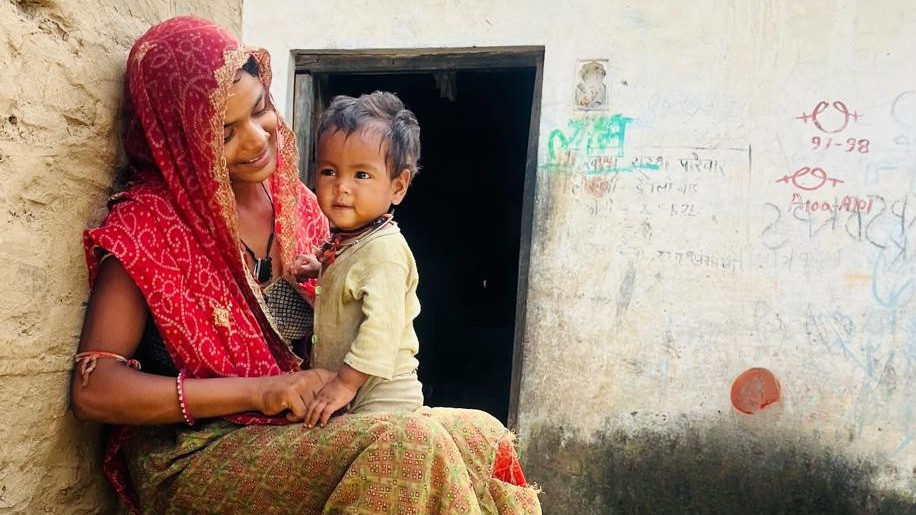
Over the past year, ARTH has implemented Navneet, a postpartum maternal-infant care intervention in rural-tribal villages of southern Rajasthan. During this time, our team has provided services to 3,252 women in the year after their delivery. On a field visit to Dhoya village, I met Jhamli, mother of four, who currently lives alone because her husband has migrated to the city for work. Jhamli feels exhausted by daily chores that stretch from morning to evening, while also caring for her newborn son. We have observed that in households in which the husband has migrated for work, the wife’s burden intensifies for almost everything, encompassing childcare, cooking, cleaning, fetching water and firewood, and tending to goats and cattle. In the same village, Rekha, who lives in a family of six, described a similar experience. She said that her daily routine leaves her exhausted – her arms and legs ache and she feels listless.

A 2023 review of motherhood and mental health indicates that a sense of emotional and physical overload can evolve into anxiety and mood disturbances, which if unsupported, might tip women into postpartum depression (https://doi.org/10.7759/cureus.46209). Research shows that around 15-21% of women experience some form of postpartum mood and anxiety disorder (PMAD) (https://doi.org/10.1016/j.nurpra.2018.03.010). Against this backdrop, Preraks — trained outreach educators recruited from within the same communities, meet women at home during the year after delivery. On each visit, the Prerak engages in a friendly, informal conversation while discussing key aspects of maternal and infant health, such as nutrition, contraception, health concerns and immunization. She also encourages women to visit the clinic for a routine check-up by nurse-midwives or a doctor.

While we were sitting outside her house, Rekha began talking about the Prerak’s recent visit. She smiled and said, “Didi (sister) came to check on how I was doing. Talking to her made my mind lighter”. Later that day, Jhamli shared, “my sisters-in-law got a sterilisation, but I was scared, so I didn’t get it done. When Didi (Prerak) explained about Mukti (hormonal IUD), I felt relieved. Next month, when my husband comes home, I will go to get Mukti”. Thus, Preraks build a relationship of trust, transforming into a friend who sincerely cares.

For their part, Preraks see their role as going well beyond delivering information. One of them said, “Most women talk to me about family matters – about husband, mother-in-law, household, money, everything. They feel good that someone has come to meet them”. Another Prerak added that women often call them up later, if they have questions or need advice. Preraks are backed by counsellors of ARTH’s telephone helpline located at Udaipur, who speak the same dialect and provide additional guidance when women call. They also proactively schedule check-in calls to enrolled women.
Although we might not be able to reduce the physical workload that women have to endure, we hope that by creating a trusted relationship through home‐visits and telephonic follow-up, the Navneet intervention will help to prevent postpartum depression (PPD). Simultaneously, addressing anaemia and debility, enabling contraceptive choice and treating infections also should help, by meeting the major health needs of this period. Recently, the World Health Organization has emphasized that maternal well-being depends on supportive care, strong social relationships, health care, and the ability to make decisions for oneself. Meanwhile, we are working to strengthen the circle of support around new mothers so that they may return to their daily routine and restore the relationship with their husbands, and are able to enjoy rather than merely endure motherhood.
– Himani Sharma (pa.hs@arth.in)