
(World Population Day, 11 July 2025)
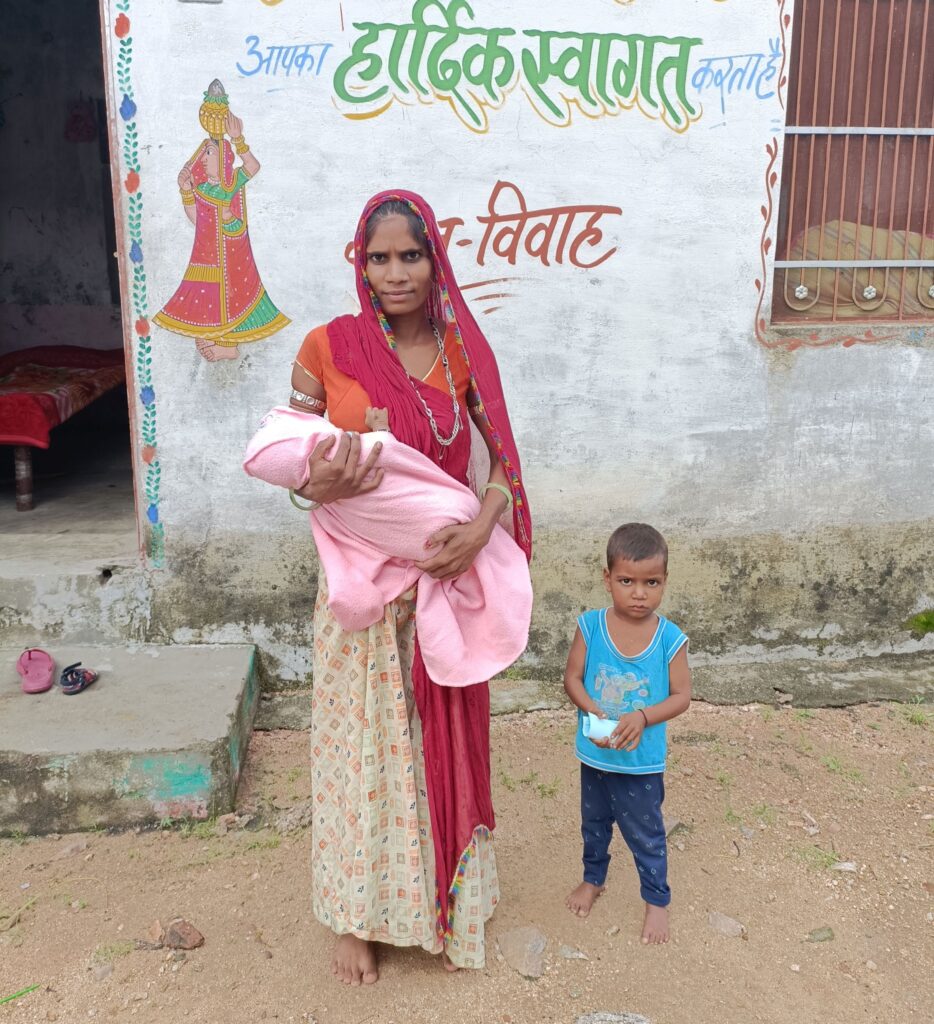
As I climbed the path leading to her modest house located on a forested hill in Shivdiya village (44 km from Udaipur, Rajasthan), I found Dakudi (26 years) busy cooking a meal. Her four year-old son was playfully splashing water from a bucket outside the house and a four month-old daughter was crying softly inside. While I waited, Dakudi moved back and forth, comforting the baby, making sure the rotis didn’t burn on the pan, and rebuking her son for wasting water that she had fetched from a distance. After feeding and soothing the baby, she finally came outside and sat beside me.
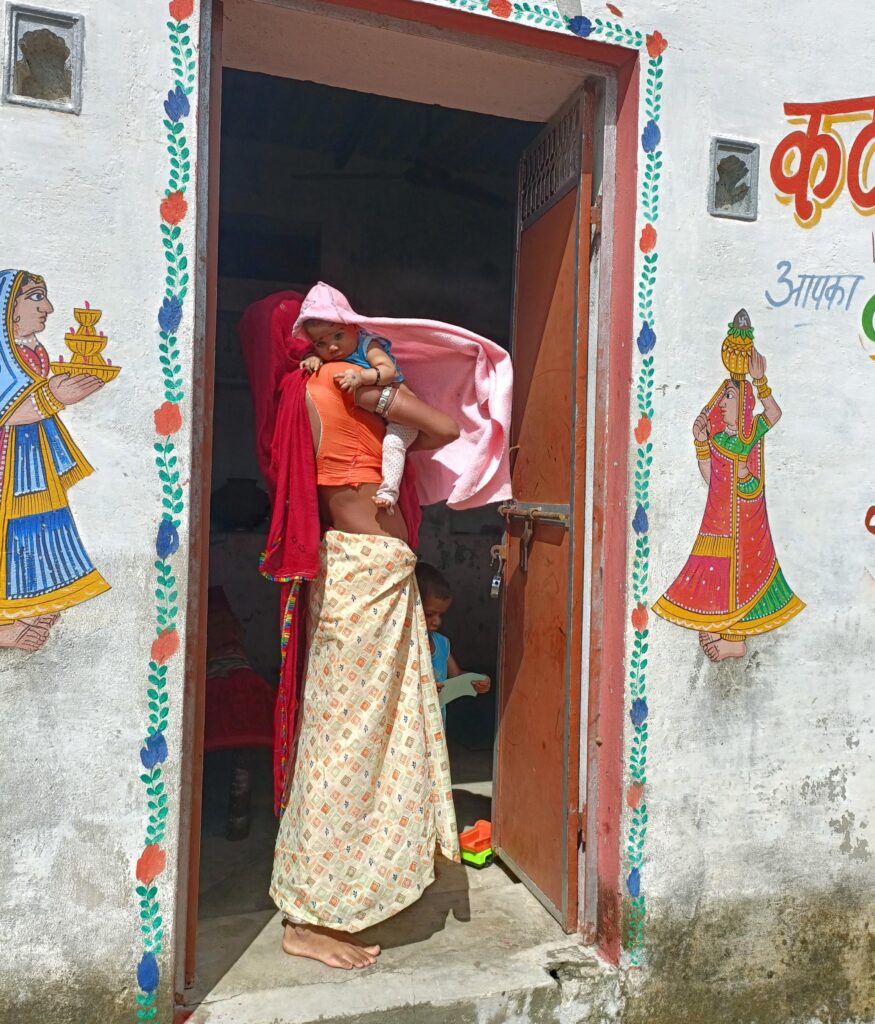
She smiled in welcome and said, “No one comes here, Didi. What brought you all the way to meet me?” I told her I wanted to meet her after delivery and see how she and the baby were doing. She looked happy to have someone to talk to. She lives alone in the isolated house on the hill — her husband works in a restaurant at Surat (Gujarat), visits every 3 to 4 months. Her in-laws have passed and a brother-in-law lives 2 km away, in the main village.
We spoke about her delivery and how she was doing afterwards. She recalled the event: “My husband was away when I went into labour. There’s no phone network here, so I couldn’t call anyone. I walked down the hill to the main village and somehow made it to my brother-in-law’s place. They took me to hospital.” Soon after delivery, a Copper-T was inserted. “I didn’t want it. but I was scared, so how could I say anything? My husband wasn’t there. So I just kept quiet.” When her husband came home a month later, he accompanied her to a clinic where she got the device removed. “It’s not that I want another child right now” she said, “but I didn’t want the Copper-T. I was worried that it might cause a problem”. A few weeks later, Dakudi came to know about a contraceptive injection from the Anganwadi worker of her village. Two months after delivery, a government auxiliary nurse-midwife (ANM) gave her a DMPA injection at the same anganwadi. She says it feels just right for her.
While postpartum contraception plays a critical role in supporting women’s health, their ability to make real choices is often limited. During 2019-21, ARTH surveyed 1,029 women in villages of southern Rajasthan, one year after their delivery. Of these, 33% had initiated contraception, including 114 (11%) that had a Copper-T inserted at the time of delivery. During the year, 56 (49%) of these 114 women got the Copper-T removed, while another 18 (16%) had a spontaneous expulsion. Hence by the end of one year, only 40 (35%) of the postpartum Copper-Ts remained in place. This raises the question of how and why such a large proportion of women discontinue within months, a long acting contraceptive method is effective for as long as 10–15 years.
This year’s State of World Population 2025 highlights the lack of reproductive agency among young women and men across the world. In India, 27% of women have experienced situations in which they were unable to use the contraceptive method of their choice.1 Irudaya Rajan and Andrea Wojnar argue that India’s real fertility crisis is not about falling birth rates, but about the overlooked realities of limited choices and missed opportunities that prevent individuals from achieving their desired family size, whether that means pursuing pregnancy or preventing it.2
For women of limited means like Dakudi, who run their homes and rear children alone in the rural interiors of Rajasthan, making decisions on contraception is even more challenging. And yet, her ability to even belatedly exercise choice, represented an act of persevering resilience.
Gunjan Khorgade (gk@ccr.arth.in) & Sharad Iyengar
1: https://www.unfpa.org/swp2025
2: https://www.epw.in/journal/2025/26-27/comment/changing-fertility-behaviours.html